Purandar
Fort Images
Explore Various Images of the Fort
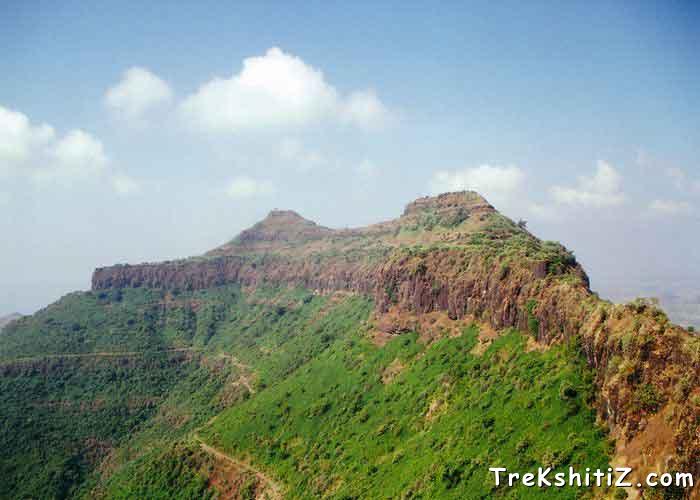
Vajragad from Purandhar Machi
Introduction
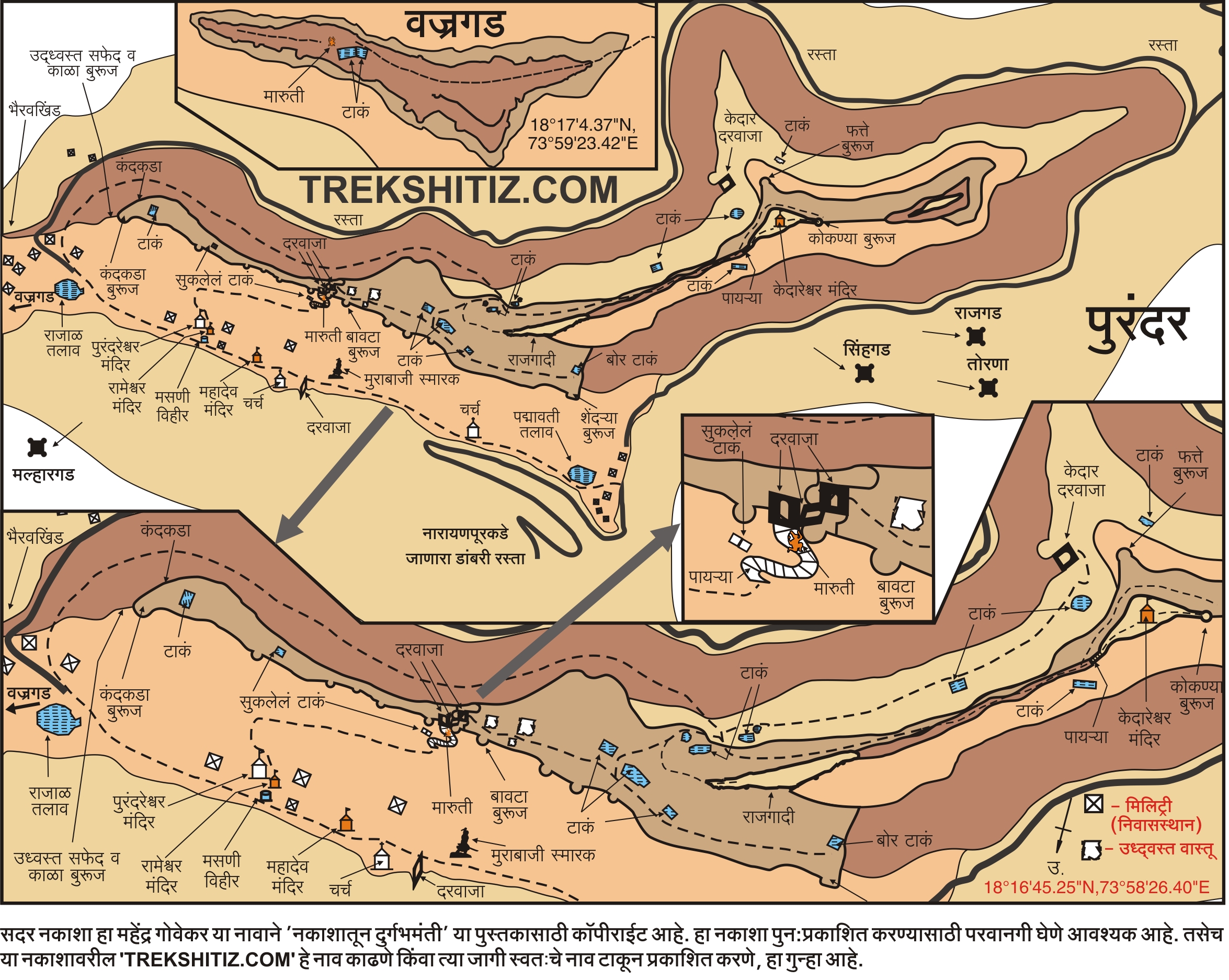
The Sahyadri , which stretch along the north-south direction, also have ranges that branch off eastward. On one of it Sinhgad stands. The same range continues for 24 kms before terminating at Bhuleshwar. On this very range lies the prestigious “PURANDAR FORT” along with Vajragad. We have to travel across Katraj ghat, Bapdeo ghat and Dive ghat to reach upto the foothills of the fort. The fort is covered by plateau region on all its sides.
Purandar fort is located approximately 20 miles south-east of Pune and 6 miles south-west of Sasvad. Sinhgad is about 13 to 14 miles north-east of Purandar while Rajgad lies 20 miles to the west.. The western side of the fort is a mountainous & towards east is largely a plateau region.
The fort, being quite a huge one was a good place for defence. It had the capacity to house many soldier-troops, foods grains and ammunition which proved sufficient for long durations during wartime. Nonetheless, the fort hosts strong fortified places from which a watchful eye can be kept over surrounding areas.
Historical Background
Near the foothills of Purandar, is the small village called Narayanpur. In this village is a temple of Lord Mahadev constructed sometime during the Yadav’s dynasty. The fort is thus blessed with a history of around 1000 to 1200 years.
Just as Lord Indra occupies an undisputed position among gods and goddess, same is the status of Purandar among other forts. Its mythological name is “Indraneel Parvat”. As per Hindu mythology, when Lord Hanuman attempted to carry Dronagiri mountain range, a portion of it slipped off his hands and fell down to form “Indraneel Parvat”.
The history of this glorious fort dates back to the Bahamani Regime. Chandrasampat Deshpande of Bedar first acquired this fort. The work of reconstruction of the fort started by Chandrakant Deshpande was completed with great zeal by one of his family associates Mahadaji Nilkanth. Later, somewhere around 1489, the fort went into the hands of Nizamshah, won by his brave sardar Malik Mohammed. Further, it went into Adilshah in 1550.
It so happened during 1649, Adilshah was furious by the great deeds of Shivaji Maharaj since he had captured many forts, which were previously under control of Adilshah. Adilshah, therefore arrested Sahaji Raje and Summoned Fatehkhan to get hold of Shivaji. Dark clouds of uncertainty and fear hovered over Shivaji as the situation was really critical. It was like a huge mountain on one side and a deep valley on the other. His father was in the custody of Adilshah and the marching Fatehkhan on the other side was a real threat of ‘Swarajya’. Recognizing the inevitability of a fight, as a part of a strategic decision, Shivaji Maharaj opted Purandar fort, aa a suitable place for battle. However, inspite of the fact that the same fort was not in hands of the Marathas, it was a calculated risk which he had taken within no time, though, he managed to establish his supremacy over the fort using Gusiella technique.
During those days one Nilogee was incharge of the operations of the fort on behalf of Adilshah. He had two younger brothers Pilaji and Shankarji. Shivaji sent a letter to Niloji conveying the news of the death of Dadoji Kondadev who was a fatherly figure to him. Maharaj expressed about him feeling like an orphan and since Niloji had a fairly good alliance with Dadoji Kondadev and his family he expected some hospitality in return from Niloji. He also conveyed that Maharaj himself and his followers would do what Niloji says and will not be of any nuisance to Niloji nor interfere in operations of the fort.
Looking at such humble approach of Maharaj with some soft corner for Dadoji Kondadev, Niloji readily accepted this and invited Shivaji and his followers to occupy one of the ‘machis’ of the fort and thus acknowledged the gratitude. Out of three brothers, Shankarji stayed with Maharaj.
As days passed, the festival of Diwali was fast approaching. This was when Shivaji Maharaj made his first move. He knew that Niloji, the elder brother of Shankarji, had restricted Shankarji to extend his services on the fort and with this Shankarji was unhappy.Hence, Maharaj promised him the justice. At the auspicious occasion of Diwali, Maharaj and Shankarji visited Niloji on the fort and stayed there for almost three days. Shivaji Maharaj was well aware of the differences that existed between the two. On the forth night Shankarji and Pilaji approached Shivaji Maharaj, had already established a good grip, he along with 25 Mavalas arrested not only Niloji but also Pilaji & Shankarji thereby establishing a supreme control over the fort.
With this fort as base, the Marathas entered into battle with Fatehkhan, which they subsequently won. It was a triumph of Shivaji. Later in 1655, Maharaj nominated Netaji Palkar as the “Sarnaubat” of the fort.
Maharaj’s son, Sambhaji, was born on Vaishakh Shudhha 12, Shake’ 1579, ie., 16th May 1657, Thursday on this fort.
Year 1665 marked the most devastating year as Mughal Sardar Jaisingh made a lot of Purandar fort. At that time the fort was under the supervision of Murarbaji Despande. A 2000 strong infantry backed him. Selecting 700 strong troops, Murarbaji ventured into battle with Dilerkhan who was nominated by Sardar Jaisingh and backed by 5000 strong infantry. Dilerkhan was marching upwards from all directions on to the Purandar fort. However, first Vajragad was lost and later inspite of a valiant performance by Murarbaji’s troops, the fort of Purandar fell into the hands of Moguls. Later when Shivaji Maharaj understood of his defeat, he entered into treaty with Mogul Sardar Jaisingh in which he agreed to surrender 23 of Mogul forts won by Marathas. It dates 11th June 1665. The 23 forts that were surrendered to Moguls were as follows:
1) Purandar, 2) Rudramala or Vajragad, 3) Kondana, 4) Rohida,
5) Lohagad, 6) Visapur, 7) Tunga, 8) Tikona, 9) Prabalgad,
10) Mahuli, 11) Manaranjan, 12) Kohoj, 13) Karnala, 14) Songad,
15) Palasgad, 16) Bhandargad, 17) Nar-durga, 18) Margagad,
19) Vasantgad, 20) Nangagad, 21) Ankola, 22) Khirdurga (Sagargad) &
23)Maangad.
On 8th March 1670, Nilopanth Muzumdar revamped boundaries of Swarajya by establishing control over the fort. Later, after the death of Sambaji Maharaj, Aurangazeb conquered the fort and renamed it as ‘Ajamgad’. Again, on behalf of Marathas, Shankarji Narayan argued with Mughals and took control of the fort. Subsequent to that, in Shake’ 1695, Chhatrapati Shahu Maharaj handed over the reigns of the fort to Peshwas.
It was the capital of Peshwas for many years then. Shake’ 1697, i.e. 1775, marked the birth of Sawai Madhavrao. In the year 1818, British took the charge of the fort.
Trek Duration
⏱️ Approx. 1 hour is required from the base viillage, Narayanpur to reach to the fort-top.
Facilities & Amenities
Accommodation
Available in military camps/bungalows situated on the fort. Note that prior permission of the officers is needed to get this accomodation.
Food
You have to make your own arrangement for food.
Water
Available the year round.
Best Season to Visit
🌤️ N/A
Other Forts in Pune
Planning Your Trek?
Pack Smart
Carry essentials, water, and first aid kit
Start Early
Begin your trek early in the morning
Trek in Groups
Always trek with companions for safety
Keep Forts Clean
Do not litter on forts. Do not damage the fort.